

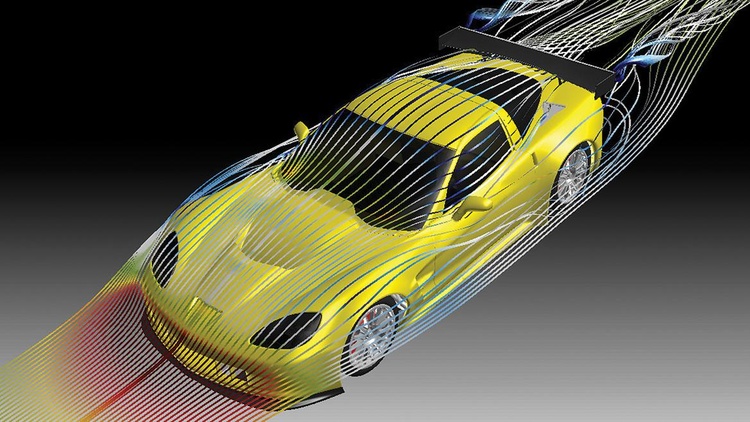
For decades, automotive design was dictated primarily by aesthetics, engine power, and structural utility. Car buyers prioritized horsepower, cabin space, and styling cues that reflected the cultural trends of the era. However, as global energy demands shifted, fuel prices fluctuated, and environmental regulations tightened, automotive manufacturers faced a new engineering imperative: maximizing efficiency without sacrificing performance.
At highway speeds, a significant portion of a vehicle’s energy is not spent overcoming the mechanical friction of the drivetrain or the rolling resistance of the tires. Instead, it is consumed by pushing through an invisible yet formidable barrier: the air. This reality has elevated automotive aerodynamics from a specialized niche of race car engineering to a cornerstone of modern consumer vehicle design. Understanding how air interacts with a moving vehicle is essential to understanding modern fuel economy and the future of transportation.
The Physics of Air Resistance
To understand automotive aerodynamics, one must first recognize that air is not empty space; it is a fluid. Like water, air has density, viscosity, and mass. When a vehicle moves forward, it must physically displace the air in front of it and pull the trailing air along behind it.
The primary aerodynamic force opposing a vehicle’s forward motion is aerodynamic drag. The relationship between a vehicle’s speed and the drag force it experiences is governed by a fundamental formula in fluid dynamics:
Where:
-
$F_d$ is the drag force
-
$\rho$ (rho) is the density of the air
-
$v$ is the velocity of the vehicle relative to the air
-
$C_d$ is the coefficient of drag
-
$A$ is the frontal area of the vehicle
The most critical variable for drivers to note in this equation is velocity ($v$), which is squared. This means that drag does not increase linearly with speed; it increases exponentially. If a vehicle doubles its speed, the aerodynamic drag increases fourfold. At city speeds of 25 to 30 miles per hour, aerodynamic drag is relatively negligible. However, as a vehicle accelerates to highway speeds of 65 to 70 miles per hour, overcoming air resistance can account for more than 50 percent of the total engine power required to keep the car moving.
The Drag Coefficient Explained
When automotive reviewers and engineers discuss aerodynamics, they frequently reference the coefficient of drag, abbreviated as $C_d$. The drag coefficient is a dimensionless value that measures the inherent slipperiness of an object as it moves through a fluid environment. A lower $C_d$ indicates that the shape of the vehicle allows air to pass over, under, and around it with minimal resistance.
To provide context, a perfectly flat square plate oriented perpendicular to the airflow has a $C_d$ of roughly 1.28, representing extreme resistance. A perfectly smooth teardrop shape, widely considered the most aerodynamically efficient natural form, has a $C_d$ of approximately 0.04.
Modern passenger vehicles generally fall within the following ranges:
-
Standard SUVs and Pickup Trucks: 0.35 to 0.45 $C_d$ (due to high ground clearance, large frontal profiles, and boxy rear ends)
-
Standard Sedans and Hatchbacks: 0.26 to 0.32 $C_d$ (benefiting from lower profiles and tapered roofs)
-
High-Efficiency Hybrids and Electric Vehicles: 0.20 to 0.24 $C_d$ (engineered with extreme focus on minimizing air resistance)
It is vital to remember that the drag coefficient alone does not determine the total drag force. Total drag is the product of the $C_d$ and the frontal area ($A$). A massive pickup truck and a sleek sports car might hypothetically share a similar $C_d$ if their shapes are equally optimized, but the truck will still experience far greater total drag force because its frontal area is significantly larger.
Anatomy of Aerodynamic Drag: Pressure and Skin Friction
The resistance a vehicle encounters is composed of two primary elements: pressure drag and skin friction. Understanding these components explains why modern vehicles have transitioned from the sharp, rigid corners of the 1970s and 1980s to the organic, flowing contours seen today.
Pressure Drag
Pressure drag, also known as form drag, occurs because of the pressure differential created between the front and rear of the vehicle as it moves. As a car drives forward, it compresses the air molecules directly ahead of it, creating a zone of high pressure. Conversely, as the car moves away from the air behind it, a vacuum-like zone of low pressure is created at the rear.
This pressure differential acts as an aerodynamic brake, pushing backward on the front grille and pulling backward on the trunk or rear bumper. The larger and more abrupt the rear termination of the vehicle, the larger this low-pressure wake becomes, resulting in higher fuel consumption.
Skin Friction
Skin friction occurs at the molecular level where the air makes direct contact with the exterior surfaces of the car. As air flows over the paint, glass, and body panels, the molecules closest to the surface cling to the vehicle due to friction, creating a boundary layer. While skin friction contributes less to overall drag than pressure drag in passenger cars, reducing it through smooth body panels, minimized panel gaps, and flush-mounted windows remains a priority for high-efficiency vehicle designs.
Key Design Features That Optimize Airflow
Automotive designers utilize a variety of exterior design elements to manage airflow, stabilize the vehicle, and minimize the low-pressure wake that destroys fuel economy.
-
Tapered Rooflines and Fastback Designs: Gradually sloping the roofline toward the rear of the vehicle allows the airflow to remain attached to the body of the car longer, reducing the size of the turbulent low-pressure wake.
-
Underbody Paneling: The underside of a standard vehicle is traditionally cluttered with mechanical components like the exhaust system, driveshaft, and suspension components. This uneven surface creates immense turbulence. Modern eco-conscious designs feature flat plastic or composite panels under the chassis to create a smooth floor, allowing air to pass underneath without restriction.
-
Active Grille Shutters: Internal combustion engines require airflow through the front grille to cool the radiator. However, this open cavity creates substantial internal drag. Active grille shutters automatically close at highway speeds when the engine does not require maximum cooling, redirecting air over the hood instead of trapping it inside the engine bay.
-
Air Curtains and Air Dams: Located at the lower corners of the front bumper, air curtains guide airflow through narrow vertical slots and project it smoothly across the outer faces of the front wheels. This minimizes the chaotic air turbulence generated by spinning wheels and open wheel wells.
-
Flush Door Handles and Side Mirrors: Eliminating protrusions along the sides of the vehicle keeps the boundary layer of air moving smoothly without generating localized pockets of resistance.
The Direct Impact on Fuel Efficiency and EV Range
The ultimate goal of managing these aerodynamic principles is to reduce energy consumption. For traditional internal combustion engines, lower aerodynamic drag translates directly into saved gallons of gasoline or diesel. For electric vehicles, it directly yields extended battery range on a single charge.
Industry consensus indicates that a 10 percent reduction in aerodynamic drag yields roughly a 1 to 2 percent improvement in fuel economy during city driving. However, because drag increases exponentially at higher velocities, that same 10 percent reduction in drag delivers a 3 to 5 percent increase in fuel efficiency at highway speeds.
For electric vehicles, the impact is even more pronounced. Internal combustion engines are highly inefficient, wasting up to 60 to 70 percent of their fuel energy as heat. Electric powertrains, on the other hand, are highly efficient, converting over 80 percent of stored electrical energy into mechanical motion. Because EVs waste so little energy internally, exterior factors like aerodynamic drag represent a massive portion of their total energy expenditure. Consequently, optimizing aerodynamics is the single most cost-effective method for EV manufacturers to boost highway range without adding heavy, expensive battery cells.
Frequently Asked Questions
Does driving with the windows down affect fuel economy more than using the air conditioning?
At lower city speeds, driving with the windows down is generally more efficient because air resistance is minimal. However, at highway speeds, open windows disrupt the engineered airflow over the cabin, creating an aerodynamic parachute effect that significantly increases drag. At speeds above 55 miles per hour, closing the windows and running the air conditioning is typically the more fuel-efficient choice.
Why do some highly aerodynamic cars look unusual or unconventional?
Aerodynamic efficiency favors specific geometric shapes, primarily the teardrop profile, which features a rounded front and a long, gradually tapering tail. When designers prioritize achieving the absolute lowest possible drag coefficient, the laws of physics naturally dictate a vehicle shape that features a sloping hood, covered wheels, a tapered rear, and a tall tail end, which can clash with traditional consumer styling expectations.
Do aftermarket roof racks and cargo boxes impact aerodynamics when empty?
Yes, aftermarket roof accessories severely compromise a vehicle’s aerodynamic profile. Even when empty, crossbars and cargo boxes create localized turbulence, increase the frontal area, and disrupt the laminar airflow over the roof. Keeping an empty roof rack installed can decrease highway fuel economy by 5 to 15 percent depending on the vehicle shape.
What is the difference between laminar flow and turbulent flow?
Laminar flow refers to air moving smoothly in parallel layers over the contours of a vehicle with minimal disruption. Turbulent flow occurs when these layers break apart, creating chaotic, swirling eddies of air. Turbulent flow increases skin friction and pressure drag, which causes the engine or electric motor to work harder to maintain speed.
How do wider tires impact the aerodynamic efficiency of a vehicle?
Wider tires increase the vehicle’s total frontal area, which directly increases the total drag force. Additionally, wide tires project further out into the oncoming air stream, creating more turbulent airflow around the wheel wells unless mitigated by specialized aerodynamic air curtains or wheel deflectors.
Why do many modern hatchbacks and SUVs have a small spoiler at the top of the rear window?
While sports car spoilers are designed to generate downward force for high-speed cornering grip, the small spoilers on the rear of SUVs and hatchbacks serve an aerodynamic separation purpose. Because these vehicle shapes end abruptly, a clean edge at the roofline forces the passing air to detach cleanly from the body rather than rolling around the rear window, which helps control the size of the low-pressure wake.
